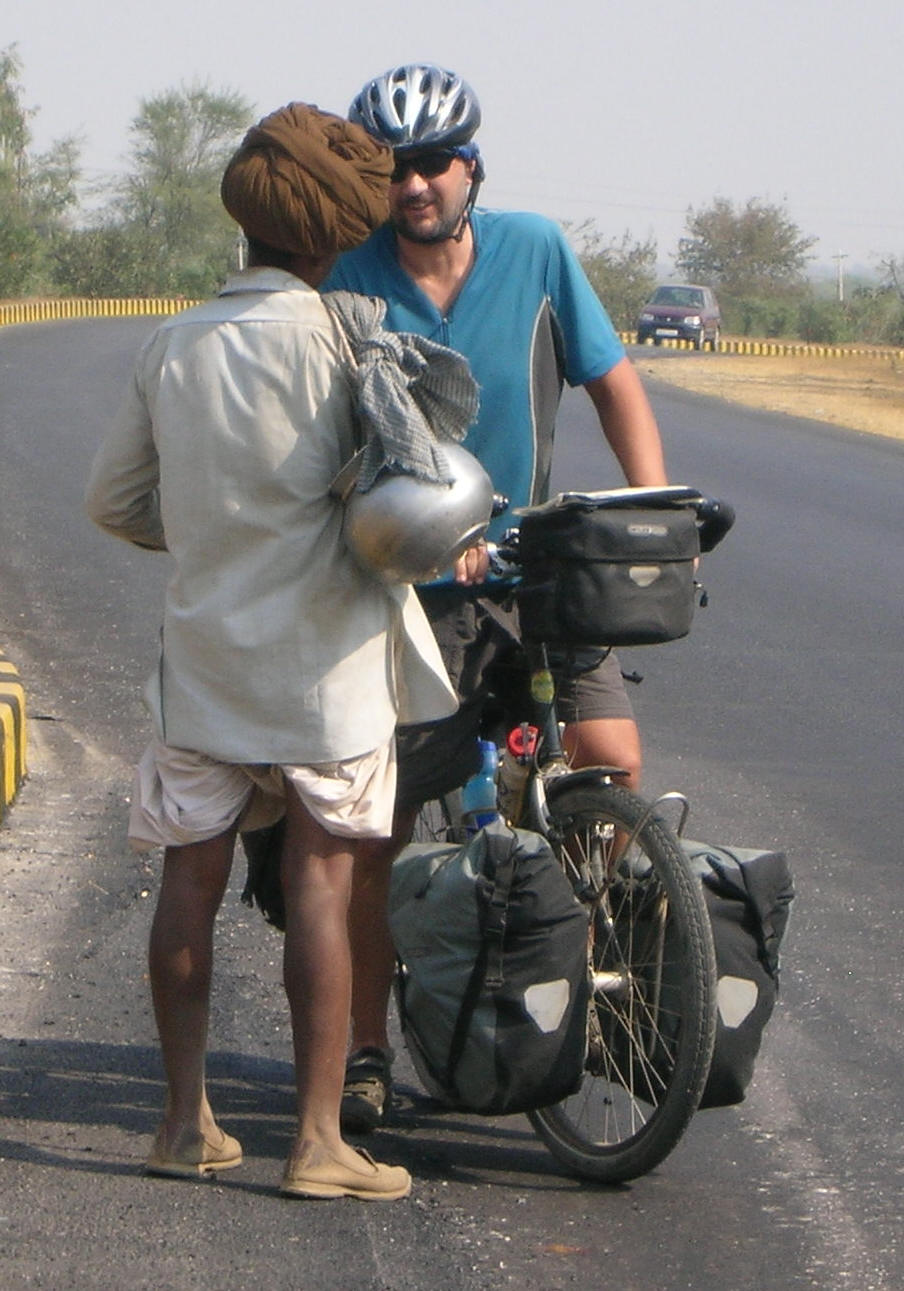
January 14, 2012 Jaipur to Naiwai 65 kilometers
We
left on the day of the Kite Festival. It's an actual holiday, as in many
stores are closed up and everybody is out flying kites. The kites
speckle the sky like confetti. They are simple square kites made of
crepe paper or plastic, little or no tail. The trees are festooned with
captured kites, like the Kite-Eating Tree in Charlie Brown comics.
Everyone on the street is staring up into the sky, or jerking at a
little invisible string. The little boys have long sticks to whack
stranded kites out of trees and power lines. It was great fun to watch
as we exited the city, a ride that took over an hour. I don't know how
big Jaipur is, but it took forever to get out of all new construction
and suburbs and new developments on the outskirts. We ate lunch outside
of a big temple, fried dahl and vegetable and roti, with cone-shaped
terra cotta pots of sweet lassi. A kid dressed in a dusty raggedy Monkey
God costume wandered by hooting at us.
Civilization gradually dropped away and we were
suddenly out in the desert. Brown and stubbly, there may have been crops
in the fields at some point but they're all gone now. It was windy and
bleak. My skin lost all moisture. Camel carts passed by. As my speed
drooped in the headwind, I suddenly remembered that I don't like the
desert. Why had I let Tim talk me into coming to this dry dusty place?
Why hadn't I argued more for peddling south and visiting turtle beaches
and partying in Kerala? Pissed at myself for signing up for 3 months of
chapped lips and bleak landscape, I silently fumed for a the last couple
hours of riding. Tim saw how much I was struggling and offered to set up
camp for me right away. Camping in the dust didn't appeal to me at all
so we continued on with me setting the pace at a grumpy 10 kph. Finally
we came to a crossroads, one road leading to a town that had a hotel.
Naiwai lay at the base of a rocky mesa we'd been watching all day on the
horizon. As we approached, we could see the walls of an ancient fort
built at the top of the mesa, kites flitting about the rocky walls.
Weird hairy long snouted piggies scampered about the streets. Camels
snorted by. (Okay, I love the camels and my life will be complete when I
get to pet a baby camel.) We pulled into a hotel with a big welcoming
sign, a moth-eaten plush tiger in the hallway and a peaceful grassy
backyard.


The hotel owner told us that all the restaurants were
closed for the holiday so he would take us to his house to have dinner
with his family. His wife and two daughters served us and watched Dance
India Dance while we ate. I got a Hindi pronunciation lesson from the 12
year old daughter, who was adorably gawky. The food was awesome, lots of
veg and dahl and interesting dabs of chutney. (Indian chutney has
potential; I'm still not used to the taste but it could turn into my
next yummy tangy sauce like Mexican salsa or Korean kimchee.) Dessert
was the best part with a dish of “carrot sweets.”
January 15, 2012 Naiwai to Tonk 40.3 kilometers
So
far I'm not so impressed with the riding in Rajasthan. The highway is
long and straight, in the process of being upgraded to a four lane road.
The un-upgraded parts are patches on top of patches, full of
relentlessly hooting trucks. The trucks seem to be in competition for
out-pimping each other with tassels and ribbons and very loud sound
systems, speakers mounted on the outside so everyone can enjoy the
tunes. There is lots of dust and headwinds and nothing much to look at
in the barren scrublands. It's not funky fun desert like Baja or Moab. I
picture it to be more like El Paso desert, even though I've never been
to Texas outside a few airports.
 There were a few visual distractions in this
scrubland: we rode passed an un-electrified amusement park. The tired
old Ferris wheel was powered by the three men who walked on the struts
in the the middle of the wheel to make it spin, each chair filled with
an unsafe number of passengers who occasionally left their seats to
clamber around the structure with the ride operators. Loud green
parakeets wheel chattering along with the breeze. Vultures soar in
towering updrafts to glide in the upper reaches of the sky. Weathered
old men in bright turbans herd goats through the brush. In the distance,
a camel herd grazes on desert scrub brush. Farm crops are sparse. The
main business of the region is mining. Rajasthan marble is exported
throughout the world and decorates countless buildings in the region.
Even the fences are made of marble.
In the early afternoon, we pulled into Tonk, a sizable
town with interesting old mosques and temples. We rode through the
twisty streets, through the marketplace, asked a couple people about
hotels. One man on a motorbike led us up some small side streets,
stopped in front of an archeological site, gestured towards the gates
and sped away. We stared at the sign on the gate. The sign said we could
be prosecuted for defacing the site, but contained no clues beyond that.
A group of kids ran up to investigate us. One boy decided to give Tim's
pannier a rude shove when he rode by so we gave up our search in that
area and left. Back on the crowded main street, we spotted a young man
on a bicycle with racing handlebars. Encouraged to meet a local cyclist,
we tried asking him about lodging. He zipped off into traffic, stopped
to wait for us to catch up, then whizzed off again. Finally we realized
he was only trying to outrun us, not lead us anywhere in particular.
After a few more bouts of conflicting directions, we decided to give up,
head back to the highway and look for some place to camp in the dust.
Tim is an expert at roadside guerilla camping. I am far less rugged. At
this point, I was pretty tired of the whole business and not a very nice
person to be around. The afternoon did make me realize how much help we
got in Bangladesh, when every day perfect strangers would regularly take
time from what they were doing to lead us around town to find a decent
place to stay.

Back on the highway we found out where all the hotels
had been hiding. We checked into a decent enough place and chatted with
a French couple who'd stopped for a break on their drive from Bundi to
Jaipur. They assured us that Bundi was fantastic. Our room was decent
but the water is so cold and the temperatures drop fast once the sun
goes down. Who knew I'd be wishing for a nice warm hat in the desert?
Late at night we noticed the growing clamor of many
conversations outside our room. I poked my head out the door and found
the large hallway full of chatty old men lying around in mats and
blankets. There were at least twenty of them happily arranged on the
floor like a little old man slumber party. Just like the kids, they had
a hard time quieting down and woke us up a few times with their chatter.
The next morning the hotel staff informed us that they were pilgrims on
their way to some holy site. Not sure if they're walking or in vehicles,
but my guess is a bus since they all seemed clean and chipper, not tired
out from walking all day.
January 16, 2012 Tonk to Deoli 59.6 kilometers
Today's ride was perfectly level and straight on a
bumpy road. There's plenty of road construction, meaning we had to
switch surfaces and lanes frequently. Eventually this might be a regular
divided four lane highway, but in typical India fashion people drive any
which way on any old lane. The scenery was a bit greener, more crops and
less scrub. In the distance we can see hills and plateaus but we reached
none today.
We ate lunch at a truck stop. Instead of chairs,
people lounge around on wooden bed frames strung with woven rubber nets
or strips of old tires or rope. People like to hang out in the sun here,
maybe they are really feeling cold in the winter. It's not cold at all,
really a perfect temperature for cycling. Lunch is chapatis and dahl,
less rice and more bread. The truck drivers sipped tea and took
bucket baths in their undershorts. They definitely monitored our every
move during lunch but generally gave us space.
Tim really wants to camp out here and keeps pointing
out likely camp spots. I suppose we will eventually but it doesn't look
so appealing to me, too much dust and thorns. We got a nice wheel-in,
ground floor room just outside of town instead and had room service for
dinner.
January 17, 2012 Deoli to Bundi
We finally reached the hills today and, man, did it
wake up my legs! Even with the constant dodging around bad pavement, the
long straight flats do not inspire me to cycle fast. I think Tim would
love to be riding faster. If I were better at drafting, I could stick on
his wheel and follow along, but with the rough road and traffic I can't
stay on. Once we got in the hills, I got into the novelty of climbing
and jetted right up. There was one old fort sitting up on a desert hill.
I bet there are bunches of abandoned old forts out in the desert.
Another tasty lunch stop at the truck stop. I asked
the owner where the toilet was and he motioned me around back the
building. I went around back and discovered a field of waist-high
bushes.
We passed a lot of mine traffic and some foul smelling
kilns. I don't know what they were cooking in those big ovens but it
really stank.
It was really cool arriving in Bundi because the view
of the castle, the fort walls, the blue buildings and the lake all hit
you at once. We rolled into the first hotel on the strip and negotiated
a good cheap room (rp250 a night). The garden was full of big monkeys
crashing around in the trees. The hotel staff gave them chapatis to keep
them from defoliating the tastiest shrubbery. We found out that some
other cyclists had just left that morning – some Germans riding
recumbent trikes, pulling a trailer with their two dogs.
For dinner we tried a Rajasthani thali. It had a
pumpkin curry and came with a bread crumble mix, which together tasted like
spicy pumpkin pie.
January 18 – 20 Bundi

Bundi is a town that might save Rajasthan for me. The
old city buildings are ancient-looking with intricate ironwork and
cupolas and towers and cool secret passageways and twisty windy lanes to
explore. Many of the buildings are painted blue and looming over the
town is a big castle. The castle entrance is a huge gate for the
elephants to walk through. On the second story surrounding the courtyard
are the fancy balconies with cool marble columns for the Rajput ruler to
lounge about with his servants and dancing girls. There's a screened-in
section for the ladies in purdah, they can see the action from lattice
work windows in the wall. The ladies get to hang out in the coolest
garden with a big pool in the middle. Some of the old wall murals have
been saved or restored. They depict war elephants fighting, troops
amassing, fields a blooming. Some of the paintings are done in flaking
gold, some have obviously been repainted, not always with so much
talent. Also there is the hugest bee hive swarming over the entrance. We
couldn't explore all of the rooms, but we found plenty of little nooks
and neat places to look out over the blue village. I found my perfect
little blue reading nook I'm going to make someday. The windows are
covered with colored stained glass set in a lattice.


Foreigners must pay a higher entrance fee than Indians
to enter the castles, and there's another charge for cameras. And the
attendants do check your camera tickets! I tried just paying for one,
but a guard saw Tim's camera and insisted we pay the full price for a
video camera. Even though we weren't shooting any video, we paid the fee
only to have both our cameras mysteriously stop working not five minutes
after we'd handed over the cash. I'm sure we'll make up for that small
gap in the castle photo record. I think I could get into castle
exploring, but a few pictures of marble carvings and restored murals go
a long way.
January 21 Bundi to Bijolia 69 km
 Bundi
was hard to leave but the ride made up for it. We finally hit some real
natural spaces today and cool scenery. We left town on a side road,
opting for a more direct route on a smaller road. It took some asking
around but finally we got on a little-used road and headed back out into
countryside. Slight hills that appeared to be an ancient lava flow,
black rock pitted with thorn brush and lichen. We topped a long hill
with a nice view of the desert landscape, red beige hills and a shallow
lake on the horizon. We rode on to a savannah like region and paused to
sit on a fallen tree trunk in the scrubby shade. In the sunny silence, a
line of people materialized from the brush, tall-brown ladies carrying
bundles of sticks on their heads. They are adorned with clunking
bracelets and anklets, a few wear absurdly large nose jewelry. Their
bundles are heavy, you can see the strain in their backs and rigid
torsos beneath the bright colored saris.
Traffic was very light and the landscape was mostly
wild, we both got excited to finally do some camping. We'd spent the
morning gradually climbing to this sparse hill land and we both wanted
to find a camp spot before civilization started creeping back in. We
stopped to eat lunch at a windswept chai stand and bought crackers. A
few kilometers later we filled Tim's water bag at a small pump and tank
at a farm. A small brown face peeped around the corner of the tank and I
circled around to investigate. Two girls in red saris and a boy in a
school uniform appeared. They stood stiff for a picture and then giggled
shyly as we shook hands.
Tim's campsite radar was on full alert and long before
sunset he pointed out a dirt track running to a lakeside and some low
rock walls. “Let's follow that road and see if we can get behind the
wall. We'll be out of sight.” There we found the perfect place to hunker
down, the stacked slabs of slate blocking the wind and hiding our
campsite. The lake was created by a small dam on the opposite shore. In
the distance we heard the dull thump of explosions. Judging by the truck
traffic, there are quite a few active mines around.


I made vegetable noodle soup for dinner while Tim
turned into Handy Smurf Boy Scout super camper. I've never seen anyone
so pleased to be sitting on the ground in an old cow pasture. At night
we were woken by the yips of coyotes just outside the tent. “They're
really shy,” Tim whispered as he flicked his headlamp on and off. The
animals ran off without a whimper.
January 22 Lake camp to Abandoned homes camp 61.2 km
Some farmers visited us in the morning, full of
puzzled looks and questions. They seemed amused by our camp and motioned
that we should head over their house for breakfast. We thanked them and
declined as I was already cooking an experimental breakfast. I wanted to
make rice pudding with the ginger and spices and chunk of molasses sugar
I'd bought at the Bundi street market. I boiled the sweets together with
white rice but wasn't happy with the results. If I'd had a blender, I
could have made horchata, but as it was I'd only made a sweet rice
gruel. Then the farmers returned with food: a few chapatti, a dab of
dahl and a bowl of fresh milk. The milk was thick and gloppy, undoubtedly
unpasteurized. Just what I needed to save my rice pudding.


It was a smooth ride, a few nice hills, and a gradual
return to green agricultural land. We had lunch at a roadside
restaurant, a surprisingly filling vegetable dahl and endless warm
chapatis. I think I prefer the chapatis to rice, but they're so yummy I
always wolf down far too many. There was a rolly polly herd of fat
puppies at our restaurant. A businessman riding a motorcycle stopped in
for lunch. He quietly fed the puppies one chapati chunk after another
until the whole bunch of them was gathered up neatly underneath his
lounger. Before leaving the restaurant, we decided to fill up our water
bags in case the perfect campsite presented itself.
This area was more densely populated so guerilla
campsites were harder to find. Finally we saw a small block of abandoned
house sites. The houses were made of stone, the windows and entrances
blocked with stacked rocks. The small yards were fenced in with low
stone walls and the furthest one from the road looked like a reasonable
place to set up for the night. We tried to get off the road with no one
seeing us but one ragged goat herder boy noticed us. Soon enough, he
came visiting with more boys. They stood around the fence watching us
silently. One group of teenagers, a bit more confidently tough than
their peers, boldly strode into the yard. They planted themselves in
front of Tim and the leader made motions that Tim should give him money.
The rest of the crowd reacted disapprovingly, the old men wandered away,
gathering younger boys along the way. Tim indicated that he wasn't
paying anything. If it had been a village elder doing the asking, he
might have felt differently, but neither of us were feeling particularly
generous towards this little jerk. With a few disparaging jibes, the
boys finally left but headed into the brush rather that across the
highway to their houses. Dusk crept in and our home for the night felt
distinctly unwelcoming as we both knew that boys up to no good were
lurking nearby. Just as it got dark, the attack finally came. Two rocks
whizzed through the air, one hitting the tent and another glancing off
some rocks. We'd both been expecting it so it wasn't a surprise and
there was no use in trying to outrun local kids in the dark. We sat in
the protection of the stone walls, waiting to see if it was a one-strike
attack. Boys like that, according to Tim's boy logic, will make a sneak
attack and then run away. They haven't got the patience to sit in the
dark for long.


In the middle of the night, Tim tapped me awake.
“Heads up,” he warned. A flashlight beam was coming down the path from
the highway. We watched it flash and flicker but to our surprise, it
didn't reach our tent. Instead our potential visitor turned and headed
back the way he'd come.
January 23 Camp to Chittorgargh 47.1 km
Woke up to flat tire and flat sleeping pad. I found a pottery shard under the tent that caused the bed
flattening. Stupid terra cotta, it jabbed a hole in the tent floor
too. I don't know what caused my back tire to go flat. I patched a hole
in the tube but couldn't find anything in the tire, maybe it was a thorn
needle jab.

We bounced around the bumpy road for awhile before
turning onto main highway today and, surprise surprise, it is perfect
smooth pavement and hardly any cars. It is ridiculously empty. We can
ride side by side and talk without interruption, we can take up the
whole road if we want. There are real tractor trailer trucks here, not
the funky tinsel ones but real ones pulling big shipping containers.
This road must be coming from some big port.
January 24 – 26 Chittorgargh
Chittorgargh, or Chittor for shorts, is the site of
one of the biggest forts of Rajasthan. It was the capital of Mewar for 8
centuries. We hired a tuk tuk driver to take us up to the top of the
plateau where the fort towers 50 feet over the city. Now I wish we'd
visited the fort on bikes. It's a short steep climb to the table top,
then a meandering 7 kilometer perimeter road around the assorted ruined
palaces and temples. You could easily bike it, and stop off at any
ruined temple or castle or view that caught your fancy. My favorite part
was the main entrance, a huge elephant archway with a stupendous view of
the surrounding plains. We could see Highway 76 snaking across the
patchworks of fields and a smoggy cement plant, but it's easy to picture
the epic bloody battles they fought here centuries ago. While the
warriors marched out to certain death against Muslim invaders, the women
left behind in the forts committed jauhar, choosing to burn themselves
alive rather than be captured. Gruesome.
I climbed up the eight stories of the Tower of Victory
alone, as Tim was wary of bashing his head on the low stone ceilings.
Every bit of the walls and ceilings is etched with exquisite detail,
although the steps are worn wax smooth and slippery. The tower's name is
a bit strange as it seems to celebrate what can best be described as a
tie or stalemate in battle. Outside, dozens of long tail monkeys
gamboled about in the sun, playing with their squealing babies. I was
surprised to see two monkeys grooming an ugly feral pig. They all seemed
to be good buddies. Monkeys and pigs, I guess it makes sense that
they're in cahoots.
At one stop, we saw a man with a very shiny horse. I
swear he must coat that horse with Vaseline. She was all dressed up in
fancy bridle and saddle. Her owner, eager to sell us rides or photos or
something, jerked the mare around by her mouth until she was twitchy and
irritated. She was by far the healthiest and shiniest horse I've seen in
India, but I've still no intention of being led around atop a pissed-off
horse. On our way back to the hotel, we passed a stable of four white
horses, also well-fed and healthy looking. A silver coach was parked on
the street nearby, sitting there next to the hawker stalls and fruit
carts. I wonder who can afford to keep those gorgeous fat horses and
silver coach. Cinderella? Back in the days of the Rajput, they had huge
Royal carts pulled by elephants.
January 27 Chittorgargh to old quarry 44.7 km
Looking for camp spots, we followed at path and
blundered upon an old stringy couple farming in the brush. The old man
faced me with his long haired eyebrows and black threads dangling from
his luxurious eyebrows. He glared at us intensely, then flung up his arm
towards the highway. Tim was tired, back sore and ready to camp. We
passed some unpeopled hills guarded by a sagging barbed wire fence. We
lifted the bikes over the barbed wire where it nearly touched the ground
and moved into a small old quarry. Chunks of quartz large enough to sit
on and lean the bikes against, just far enough from the road to be
hidden but not too much pushing to reach. A couple goat herders saw us,
grown ups this time, not obnoxious kids. When the sun went down we had
the desert to ourselves. That damn patch on the blow up mattress isn't
holding. Tim woke up on the ground again but keeps insisting he's okay.
If I can't repair that mattress, we'll have to find a piece of foam or
something. Maybe a fat yoga mat?

January 28 Old quarry to Udaipur 72.5 km
Sort of a long ride today. The desert is pretty much
the same but now there are more hills. The highway always has an
appropriate grade so not too much huffing and puffing uphill is
necessary. Some of the trucks on the road are pretty overloaded with
marble slabs. We saw one crashed over on its side, all the marble broken
and scattered. We also saw the blades of a giant windmill, packed on
long load flatbed trailer trucks.
Udaipur is not a hard town to ride into. The streets
get sort of narrow towards the lake, but the many signs advertising
Lassi - Handmade Books – Octopussy Hotel/Restaurant let you know that
you've entered touristlandia. We picked a place straight out of the
guidebook. It has birds and trees painted on the walls and pretty
stained glass windows. If I was the sort of girl who could shop, this
town would be paradise. I'm so envious of the Korean backpacker girls
who are dressed in head to toe brand new flowing hippie clothes.
January 29 to February 5 – Udaipur
Our hotel, in fact, most of the hotels here, have
solar panels on the roof. I know it's the desert and I ought to conserve
water but the hot water is magical. I usually just drag in my dirty
clothes so I can wash them at the same time, thus maximizing my
under-the-hot-water time. Our hotel also has a German bakery downstairs,
very authentic I'm sure, and they bake the most fantastic apple crumble.
I've been eating at least one slice a day.
Udaipur has a couple of cool castles. One you can
visit and a couple are hotels. In fact, the castle hotel here is really
where most of Octopussy was filmed, not in Bundi. If you ask the guys at
the restaurants here, they just laugh at the idea that Bundi had
anything to do with Octopussy. Some of the restaurants here play
the movie every single night. Those poor waiters.
We went to the castle one day but didn't go to the
floating palace/hotel. It's very fancy and expensive, not actually
floating but the castle covers so much of the little island that it
appears to be. You can actually hire out the fancy rooms there to do
weddings, which might be even cooler than the beach wedding in Bali or
Mexico. I saw a couple of very nice horses in town. Maybe those are for
the fancy wedding carriage. I wonder how they can afford to keep these
horses looking so great, they're not cheap animals to care for.

I bought a bird book finally. I've been really wanting
to identify some of the hawks I see flying around. I think we saw one
stork fly by one night at camp. It was expensive (650 rupees) but I
couldn't find a used copy. It's interesting to see the bookstore shelves
full of books written in English by Indian authors. Not just the
standard Rushdie and Naipaul and Roy, but lots of new hip writers. I
read One Night at the Call Center last year, actually I found it for $1
at a discount store in New Zealand. There's a literary festival at the
end of January in Jaipur, we just missed it. I would have dug it but not
enough to stick around in Jaipur longer than a few days.
February 5 Udaipur to camp
Packing up and carrying all the bags downstairs always
sucks. Camping is so much easier. Also, our bikes were locked up with
the family's bikes and somehow got extremely dirty. Like someone's been
sweeping on top of them. Both our chains are filthy now and not shifting
cleanly.
We rode north along the two manmade lakes. The streets
were decorated for some kind of celebration with cables of tinsel
blocking out the sun. We even got to ride down a red carpet. Outside of
town, we caught a pretty good headwind in the morning but in the
afternoon the wind sort of whipped around.
The ride to Mt Abu is a little longer than we'd
realized, over 150 kilometers. The desert is hillier and more
interesting in these parts so we can get some good camping in. The train
station stop for Mt Abu is a town called Abu Road and then the road
heads uphill to a plateau region, about 1200 meters high. With luck we
can find a nice mountain campsite on the way up the climb.
The weather is perfect for riding. Winter in Rajasthan
was a great plan on Tim's part. Just one look at the landscape here
tells me that any other season would be miserably hot but now the
temperature is ideal. It's chilly at night, and I still don't have a
warm hat. I couldn't bring myself to spend money on clothes after all.
We sailed out onto the divided highway, recently built
and found ourselves alone on the road. This big beautiful highway with
practically no traffic, in the middle of India. Every day I think it
will end and yet here it is again for another worry-free day of riding.
We rode side by side, chatting in the tailwind, enjoying the sweeping
desert hills rising before us.
In the late afternoon, in a patch of hills we spied a
road leading to a small reservoir. We skirted around the hill and found
a semi-flat bit of land next to the lake. The lake was filled with bird
life and we spent a lovely evening eating soup and looking up birds in
my bird book.


February 6 camp to Pindwara 70ish
No way to pee in the morning as there were too many
people standing around. The girls were sweet, laughing at our tent (“Ahh!
Look where they sleep! Right on the ground!”) but the dudes just
wouldn't bug off. We packed and went to a restaurant down the road.
Lesson of the day: pee early. Nice dahl for breakfast, tasted like split
pea soup. Later we stopped someplace for tea and they charged us 60
rupees for two chai and one itty bitty bag of chips. When I started
complaining, the guy's kid dug out the one English menu with the big
prices. We'd have paid a decent amount for regular food but they didn't
have a thing to eat.
 Rode through some gorgeous scenery, big mountain
ranges, lakes in the distance and a big swooshing downhill glide that
probably lasted 10 kilometers. That part was great except the two
tunnels! Tim speeds up but I get a little frozen and terrified when the
road in front of me is a big mysterious blackout. There could be a a
giant hole in the street that I'm about to go crashing into. No lights
in the tunnels but the reflective bits on the Ortlieb bags do the trick
with just the light from the end of the tunnel.
The turnoff from the state highway to Pindwara took us
down a narrow country road that turned to packed dirt in some spots.
Could this be the right way? We saw a few likely camping spots, a dirt
road headed towards a little reservoir. At a corner we asked some older
men on motorcycles where a hotel might be. Two painters, wearing paint
splattered clothes and carry a ladder and buckets, offered to lead the
way. They took us on a merry ride through town, turning here and there
until we arrived safely at a train station hotel. Huzzah! We'd have
never found this place! The owner and his two charming little sons
welcomed us and smilingly carried bags up to our third story room. My
heart leapt when I saw the hot water heater mounted on the bathroom
wall, but alas, the electrical system was not quite strong enough to run
the heater.
February 7 Pindwara to hill camp 42 km
Another perfect day of riding with tailwinds and that
gorgeous divided highway. We've left the rolling hills and entered a
valley between two chains of hills. Somewhere off to the right in Mt.
Abu. The book describes it as a plateau region, but from the highway it
looks more like pokey hills than a flat-top. Somewhere in those lines of
hills is a pass that we will ascend tomorrow. Tonight we'll find a
campspot on the ride up. When we arrived in Abu Road, the railway stop
for Mt. Abu, we noticed there were plentiful 'English Wine Shops,'
unusual in this region. We just couldn't resist stopping at one for a
bottle of whiskey. I rose every man's eyebrows by making the purchase
instead of making Tim take care of it.
We picked up water and vegetables and started climbing
the slope to Mt. Abu, checking every hole in the guard fence for likely
camping spots. A path leading back to some statuesque rock formations
looked a good bet. While Tim was scouting it out, an old rail-thin woman
carrying a baby with burns on half its face asked me for money. Burned
babies are a soft touch for me. Tim came back and we shuttled the bikes
and all our equipment up a treacherous rocky path to a campsite seated
at the top of a small rise with great views of the valley floor and the
rock formations surrounding us.
February 8 Hill camp to Mt Abu 19.8 km
Woke up to a gorgeous morning and it felt especially
great to be camping in such a pretty place, especially since it was my
birthday! We had birthday oatmeal and coffee, enjoying the sun and quiet
until we were discovered by children from the huddle of shacks down the
hill They giggled from the surrounding bushes, whispering and daring
each to creep closer. A skinny, rag-tag bunch they were, clothes held
together with pins and wind-calloused cheeks. We shuttled our gear back
to the road with our chattering entourage close under foot. At the
roadside, I pulled out my camera and the kids squealed. Suddenly the
bolder boys were squirming to the back of the crowd. A cool young girl,
about ten years old, presented herself for her photo-taking and leaned
artfully against the fence like an experienced fashion model.
 Our ride that day was a short jaunt up the hill to the
resort village of Mt. Abu. A good climb, the first we've encountered in
many months, but it was a dream of a ride. The climate was cool, the
views refreshing, and our gears made short work of the gradual incline.
After cycling in Sikkim, any incline less than 10% is a breeze. We
stopped for a snack at a roadside shack and watched an old man shooing
monkeys out of his wheat fields. We realized that had we climbed a bit
higher the night before, we might have been camping with monkeys. Now,
these are the long-tailed monkeys, slightly better mannered than the
maniac red butt monkeys, but I'm sure they could still make a good
nuisance of themselves in camp.
We pulled into the town in the afternoon, after paying
a 'toll' of 10 rupees each, and found the polo grounds in the center of
town taken up with a huge circus tent. Many flyers announced the
presence of a famous guru, in town for a conference on meditation.
Well-to-do Indians and a few foreigners on the streets wore name-tags
and entry passes to the event. We climbed a last little hill, passed the
World Peace Meditation Museum with Laser Experience, and found our hotel
for the night. At the entryway were two cycle tourists! Tragically they
were just on their way out, but we had a moment to gab about bikes and
traffic and routes. They were a couple from Canada, riding local bikes
with ridiculously small bags tied to the racks. “We've only got one
change of clothes. It gets a little smelly at times,” the woman told me.
February 12 Mt. Abu to Pindwara 49.75 km
The downhill out of Mt. Abu went by much too fast. We
pulled in for a snack at Abu Road and then set out back the way we'd
come in. The wind wasn't completely against us, but it wasn't really
with us either. The temperature rose dramatically once we were back on
the plains. I'd dressed in warm clothes for the downhill and got
overheated quickly in my wool socks. I cooled down a little at a faucet
at a gas station, then we set out north again. Pindwara lies at the
junction of two highways, 76 and 14, but the turn-off is a little vague.
One map shows it directly at the intersection, another shows it a few
kilometers off on highway 76. The horizon offered no clues and we
muddled around till we found the series of dirt roads leading into town.
At the railway station we found the hotel we'd stayed in before where we
got a much-appreciated welcome from the friendly owners. Once again, the
hot water heater failed but we splashed off in cold water anyway,
anticipating a night of camping. We got a different room this time,
facing the train station. We were woken up several times in the night by
thunderous train arrivals.
February 13 Pindwara to Hay Stack camp 67.1 km
A troupe of monkeys hung out on the roof of the next
door building the next morning. They looked just like a group of human
moms taking their kids to the park. The babies scampered merrily in the
overhanging eucalyptus tree while the moms lounged on the tin roof
grooming each other lazily.
Our wonderful days of riding with the wind at our
backs and a smooth uncrowded road under the wheels are over. We turned
north on highway 14 and we're back on the old style Indian road. Rutted
roads and dangerous traffic. The wind is swirly and rarely a help, the
sand is full of thorns. The homes and people we pass show more signs of
poverty. With more than 250 kilometers to go till we get to Pushkar,
we're both feeling a bit grim about the ride we're facing.


We considered taking a hotel room in a town near our
stopping point for the day, feeling a little knackered for camping. We
pulled into the first place, a resort that was vastly out of our price
range. The next one in town asked for the same price with an 8 am
checkout time. The next two said they didn't take foreigners. Tim's back
was hurting and I was pissed off and we rode into the headwinds stressed
about where we might sleep that night. We filled up Tim's water bag at a
cafe and pressed on. At a small intersection we saw a rushing canal
running next a dirt lane between the vegetable fields. We turned off and
headed down the bumpy lane and presently came to a long disheveled shed.
We moved the pile of thorn brush piled across the driveway and snuck our
bikes in. We discovered a cow milking building, a pile of hay stacked in
one corner. Birds and chipmunks scratched happily in the straw and we
smoothed out a cushy spot for our tent. Besides one old man in a red
turban we met on the road, no one saw us sneaking back into our bedroom
for the night. We spent a sweet and quiet night nestled in the hay and
went undiscovered until we left the next day.


February 14, 2012 Hay Stack to Pali 55.3 kilometers
Lovely morning. It was quiet and peaceful, besides
some very chatty birds. We saw a family of small ferret-like animals
scratching around in the bushes (no idea what they were, I haven't got a
mammal book) and a bold field mouse rustled around our campsite. No one
came to visit. On the path back to the highway, I stopped to chat with
some ladies washing clothes in the canal. The prettiest lady chatted
back bravely, the rest ducked and giggled.
Out on the road our happy morning bubble got burst.
The pavement was crap. The road is being slowly expanded but still only
in the phase of women clearing brush and leveling the dust with men
lounging around 'supervising.' Most of the roadside businesses were gas
stations for the multitudes of ratty trucks. The narrow road leaves
little room for the trucks to get around us, meaning we had too many
close brushes with death. I was in near panic mode and soon called a
stop for lunch and a chance to catch my breath. Lunch was a nice paneer
masala but our English speaking restaurant owner charged us a price
equal to a hotel room. Beware of solicitous English speaking restaurant
guys. Back on the road, we braved the truck traffic for another hour,
then pulled over at an abandoned building to take a break in the shade.
Some skinny ladies carrying loads of firewood on their heads stopped by.
First they asked for money, then food, then hand lotion. While we were
distracted by the ladies in front of us, the older gal slipped behind
them to try to rifle through my panniers! Tim, ever watchful, stood up
to shoo them all away. The raggedy school boys who'd gathered slipped
back into the brush and then threw a well-aimed rock at our bikes. Man,
I hate that. It was a disheartening moment.
A little while later a wealthy couple in a minivan
pulled us over to take some photos. Turns out they'd just been married
half an hour ago, and just met a few minutes before that! Although they
are both well-educated, they'd agreed to an arranged marriage and were
on their way to their honeymoon.
The wind was in our faces and the trucks an
ever-present hassle and I was worn to the wire. Our goal was the town of
Pali where we'd been told the highway would improve to a wider, divided
road. Just outside of town we came to a hotel and decided to check in.
The first price we were quoted was much too high but after letting the
tallest guy there have a ride on Tim's bike, the price dropped to a
manageable one. And we could roll the bikes directly into the first
floor room. The man who brought the guest registrar wanted to take a
look at my passport so he could peruse the different visa stamps. Then
he brought in a folder containing his collection of currencies from
around the world. He had money from over 80 countries, mostly given to
him by different hotel guests. He was most curious about my visa from
East Timor and was disappointed to hear that they use American dollars
there, not their own currency. I asked if he collected coins as well,
then presented him with the fistfuls of coins that have been weighing
down my bag for the last 5 countries. It really made his day, you should
have seen the smile on his face and I was delighted to give those coins
to someone who would really appreciate them. (Tim was not so delighted
to discover I'd been carrying so much useless extra weight.) I'd tried
giving coins to my nephews before and they immediately asked to exchange
them for 'real American money.' If anyone's got some extra currency
they'd like to donate to this guy's collection, especially African
money, you can send it to Arvind Bansal, c/o Motel Maharana, NH 14,
GUNDOJ, District Pali-Marwar, Rajasthan, India.
February 15 Pali to flat camp 40.3 km
Miserable day of riding. Four flats! All on my front
tire, an ominous development. We woke up to one flat. I repaired a
puncture but soon after we started it went flat again, a new hole on the
seam of the tube. I patched it again only to have it fail less than ten
kilometers later. We were battling against constant bad wind, bad roads,
and trucks that came much too close for comfort. I had dirt in my teeth
and, worse yet, I was down to my last new inner tube. While I was
stomping in the sand in frustration, three men on a motorbike pulled
over to see if they could assist and to share a bag of tiny sour apples.
That was a nice cheer up and we soldiered on. Around 4 pm, we rode
through a town inhabited by a huge ashram. They had lovely grounds, what
we could see behind the tall fence lined with barbed wire. Just past
town, we pulled off onto a farm lane. There was really no hope of
finding another haystack. The desert here is brown and dry and flat, a
mighty hopeless looking sight when you're riding into headwinds with
dust in your eyes. We settled for a bare patch of dirt hidden behind a
lump of thorns stacked high to make a fence. The thorn fence offered
some wind protection. We spread my old blue tarp, really a large rain
poncho, and sat on the dust, finally ready to relax after a tough fought
measly 40 km. Just as I raised my coffee cup of whiskey, my front inner
tube burst again and hissed itself flat into the dust.
February 16 flat camp to Barr 62.9 km
My last flat was due to a faulty inner tube that burst
at the valve. Can't be repaired. Back home I'd take it back to the shop
but there's no returns in India. That was my last new tube, I'm down to
patched tubes now and there are no Presta valve tubes for sale in this
country. I might have to let Tim get my rims drilled out, whatever that
is. I'll make due with patches for now.
We had lunch at a truckstop restaurant. They had a
huge water pipe in the corner and we noticed some of the drivers taking
shots from a soda bottle full of murky liquid. “Wine,” they told Tim.
“Driving?” Tim asked. “No, sleeping now.” They pointed at the bed frames
lined with rubber straps and mimed taking a snooze. The food was simple,
vegetables fried in sauce, chapatis baked in an open flame oven. The
drivers were friendly and curious and passed around Tim's card,
translating and commenting to each other. It's hard not to like these
guys when we meet them at the restaurants, but on the road it's a
different deal entirely.
Our map showed a railway stop at Bar, a likely spot
for hotels. We pulled into the first one we saw and after a little
negotiating, got a decent room with hot water buckets brought up. First
hot water since Mt. Abu! It's amazing how much dirt comes off with a
little hot water and soap.
February 17 Barr to thorny goat camp 53.5 km
This morning we climbed up a lovely little hill.
Orchards and rock formations and birds. It would have been a terrific
ride had it not been for the maddening onslaught of homicidal trucks,
honking at three second intervals. We got run off the road by oncoming
passers charging full blast towards us. When the landscape changed back
to flat thorny brush wastelands, we arrived in Beawar and finally turned
onto a recently finished upgraded highway. It was a dream to escape back
to smooth pavement and a road wide enough to accommodate a few bikes on
the side of the road. The road was still partially under construction in
many section, large sections of pipe waiting to be laid. Dusty
businesses lined the road, mechanic shops, smoky restaurants, industrial
support. We had a late lunch and started looking out for a place to
camp. As the area was more heavily populated, our choices were limited.
Finally we spied a path turning off, heading towards a sparse chunk of
woods. I swung down the verge and into deep sand and managed to skid
down on mt side into an ungraceful lump. At least I didn't fall into a
thorn bush. I was dusty and scraped but nothing serious. We pushed back
out of view (but certainly not out of hearing) of the highway and found
a sandy area to set up in. Tim was taking out the tent when his bike
over-balanced and fell over, flinging the water bag onto a thorn brush!
Horrified, we watched as a few drops of water oozed out of the bag, then
stopped. Apparently the holes weren't too big.
 Later we were visited by a stick-like old man in a
turban who shook his long staff in the trees to knock down seedpods for
his goats to eat. We saw a hare dashing through the long grass and bats
nipping through the encroaching night. My camping mattress goes
partially flat every evening, so we take turns using it with a coat
tucked underneath for added insulation. Blowup pads and desert camping
do not mix. At least my mattress still has some loft. If the other
mattress gets a puncture, I'm not sure it will provide any insulation
when flat. My patch kit is going to get a good work out in this
environment.
February 18 thorn camp to Pushkar
Rather than cooking breakfast, we packed in early and
scooted over to a nearby restaurant. It was run my Muslims, but still
vegetarian. After so many days of riding, we're both craving protein.
This area is devotedly Hindi and most people are vegetarians. What we
wouldn't give for some barbeque these days!
We continued down our wide dusty highway. We passed a
recent accident, two big trucks that plowed into each other hard enough
to smash and decapitate the cabs of both trucks. It was a morbid sight.
Presently we entered Ajmer. Tim dealt with a gas
station owner who didn't want to fill his MSR fuel bottle, while I
snapped pictures of the uniformed young school boys who gathered around
to admire our bikes. Kids here do look smart and interested, it might be
fun to be a teacher here. Traffic in Ajmer was the usual city craziness,
and we followed English signs around a lake and out towards a hill pass.
There is a little climb to get to Pushkar and the road is lined with
monkeys. The nice kind of monkeys but I am always suspicious that one
might suddenly get a wild monkey urge to leap on my back as I sweat my
way slowly by. After a half-hour climb, we crested and sped down the
road past dozens of signs for restaurants and hotels. Welcome to
tourist-land. Pushkar is a holy sight for Hindus and a gathering spot
for hippies from all lands. No meat or alcohol, but everything else a
weary traveler needs after weeks on the road. Pizza, hot showers, long
mornings in the cafe.
I left Tim sitting in a wicker chair and made a survey
of nearby hotels. Actually very reasonable prices and most places
promised there was hot water 24 hours. I chose one with a huge room next
to the water. Later we figured out that claims of hot water were
somewhat exaggerated, and the morning puja at the lake begins with a
great clamor of enthusiastic bell ringing. But the falafal place we
found is great and Pushkar has some of the best people watching ever,
especially if you're interested in observing the wild Dreadlocks in
their native habitat.

|